


The Debunker: Sleep Myths #2
Tuesday, August 9, 2011
Everything you know is wrong! Each week, we ask writer and Jeopardy! ace Ken Jennings (seen at left and far left) to tear down one of the lies that they teach us in school, man. During these sleepy dog days of August, Ken will expose four common misconceptions about sleep. If this one rocks your world, further world-rocking can be found in last week’s column.
Sleep Myth #2: Bears Hibernate In Winter
Quick: think of an animal hibernating. You pictured a bear, didn’t you? And not a bat, a squirrel, a rattlesnake, a spiny anteater, or a fat-tailed dwarf lemur? Well, you were wrong. All those other animals are true hibernators. Bears are not.
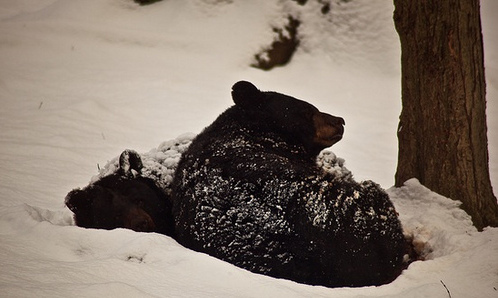
When a real hibernator—a rodent like a marmot, for example—gets down to its winter business, it doesn’t fool around. Its heartbeat lowers by a factor of seven, and it might only breathe once every six minutes. Its body temperature can drop near freezing. A bear, on the other hand, typically loses only five Celsius degrees or so of body temperature, mostly due to its larger size. If a grizzly bear got as cold as a squirrel does during its long winter nap, it would require over 11 million calories of heat to wake it up!
A bear’s winter state, more accurately called torpor or lethargy, is still a dramatic lifestyle change. Black bears can go over a hundred winter days at a time without any exercise—which, granted, is also true of many Americans. Unlike lazy people, however, bears also get around the need for bathroom breaks by eating enough roughage to form a foot-long rectal plug called a “tappen” in their bowels, which is probably more than you wanted to know. Suffice it to say that in the winter, Winnie-the-Pooh, uh, doesn’t.
Quick Quiz: Every November, what university hides its mascot statue behind a big sign reading, “The Bruin Bear is hibernating!” to keep it from being stolen by a crosstown rival?
Ken Jennings is the author of Brainiac, Ken Jennings’s Trivia Almanac, and the forthcoming Maphead. Follow him at ken-jennings.com or on Twitter as @KenJennings.
Photo by ForestWander.com, used under a Creative Commons License.
Comments
Comments are closed.