


Book Report: Chung Kuo
Monday, September 19, 2011
If you’re already familiar with David Wingrove’s Chung Kuo series, you might be happy to know it’s beginning again. Of course if you know the story, just skip a paragraph and hear the good news. But in case this is all new to you, let’s recap: Chung Kuo was seven good books and one horrible book that followed an alternate sci-fi future where the China of tomorrow controls the globe.
At their best, the scope of the books rival Dune and the Foundation Trilogy. At their worst, the series fell victim to publisher demands which pretty much trashed Book Eight. But that’s all back in the 90s, because what’s important now how the author’s doing something that possibly has never been done before: he’s redoing the entire series from scratch, in e-book form, and making it even longer.
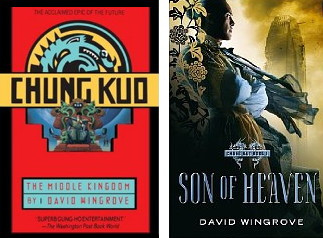
Come inside as Scott talks about the original eight book series and the new ongoing revision project. There’s a chance Chung Kuo might be just the thing to hold you over till Game of Thrones comes back.
I first picked up the hardback of Chung Kuo for a buck, because it was huge and hey, hardback for a buck, right? I knew nothing about the book and was impressed at how quick and enjoyable it was, and how easily I followed the dozens of important characters. With the battle between dominant Chinese aristocrats and some up-and-coming minor players of European descent, the books felt like James Clavell, where maintaining the feel of epic was more important than, say, authentic historical details. And really, who’s dumb enough to try and learn history from a sci-fi novel in the first place? A series like this is just for fun, and boy, is there plenty of that. The day I finished Book One, I went to the store for Books Two and Three.
Like Firefly, David Wingrove’s series was cut short by executives who just didn’t realize what they had. Like Game of Thrones, the books cover a complex grab for power over the known world and beyond. But I think the Chung Kuo series most approaches Frank Herbert, building a world in front of you, and then letting you watch it begin to bend under the weight of its history. You won’t get the depth of Dune, but it seems fair to call Wingrove at least the equal of Dune Messiah.
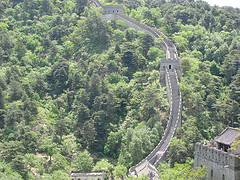

Two great ancient civilizations?
And perhaps that’s because Herbert hedged his bets by using future-humans so far beyond us they became mostly metaphor. Chung Kuo has no order of magic nuns or human calculators, just a planet covered by a man-made city, and mysterious leaders involved in game for control. Even though they use weapons and technology far in advance of our own, they’re still basically “Future Europe” and “Future China” and that means they’ll carry biases ideas like “Fremen” and “House Harkonnen” don’t immediately suggest. There are also a lot of sci-fi/fantasy cliches tucked into the books, and a hero is generally going to win because he’s the hero, no matter if he’s up in the sunshine on top of the “ice”, trapped down in “the Clay” of old Earth beneath the city, or just floating around in their cyberspace. You won’t come across many big twists, just a slow steady stream of events that will carry you along from chapter to chapter, many of which are nothing but long conversations.
But, to me at least, these decisions aren’t so bad at all. You don’t get lots of horrible pages describing intricate details of hand-waved tomorrow tech, for example, and once you know a character, there’s little chance you’ll have to learn about his replacement. That might seem like a dumb reason before you start, but come back when you’re on Book Five and see if you don’t agree. It’s also worth mentioning how the subtext of the book is the debate between the role of the individual vs the role of the nation, and in this light, a slow steady pace with occasional bursts of action seems to fit the theme.
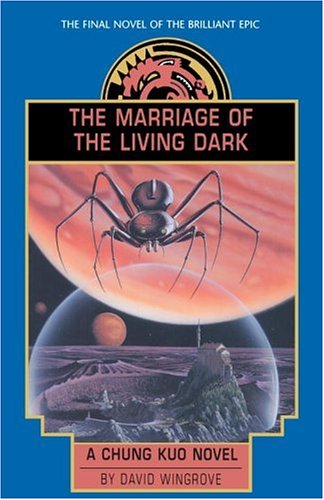
…except for this book, it suuucks.
But what actually led me to do this review was the surprising discovery that Son of Heaven existed. As I mentioned above, the Chung Kuo series was cut short, sort of against the author’s wishes, and he had to wrap things up before he’d intended. The final book in the original series is still very hard to find, and those who’ve read a copy almost universally hate it. Maybe in response to this, Wingrove’s decided to take those eight existing books and expand them to twenty, adding more to the story and cleaning up the things he was forced to make dirty.
Where the original series began with the world already conquered, Son of Heaven actually starts much earlier, telling the story of an advanced Western society just at the brink of collapse, and a single Chinese madman about to make his move. This naturally throws into question the “individual West vs collective East” themes of the earlier books, but we’re one twentieth of the way into the series, so it’s too early to predict if this is an accident or not. I’m willing to give him the benefit of the doubt on that one.
A lot of the new book takes place in a little town that seems to be cliche-Ireland, and the first chapter might set off your crap detectors immediately. Believe me, as someone who grew up and out of reading Piers Anthony and TSR novels, I felt the terror myself. But push on, because those post-collapse salt-of-the-earth stereotypes really will grow on you, and it drives home the disconnect when an incredibly civilized and advanced Han force slams into their peasant lives and takes control. There are some annoying moments where Wingrove goes off on needless tangents, but each and every mistake is matched by some fabulous event that just feels vital, to both the characters and the larger story as well. The effect for longtime readers is much like finding your puppy eating your favorite shoe, then seeing him wag his tail. If you start with Son of Heaven be aware, the book you start with is not the same book you’ll finish.
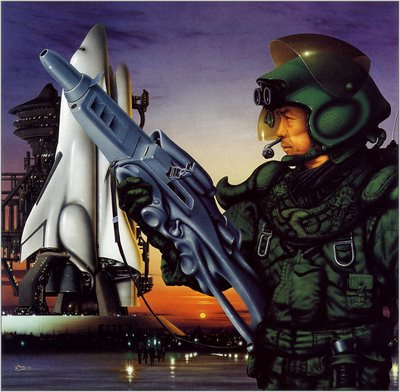 That’s a long way from the pub.
However, my advice is to approach this series the way you should Star Wars, and follow the original order. Start with a used copy of the original, out-of-print book and if you enjoy it, grab a few more as you can. Then when you’ve finished Book Seven, fall back to the new e-book and start reading them as they’re published. This way you already know a bit about the world that’s coming, but you also don’t have to endure that corporately-mandated Book Eight.
Of course, if you want some fiction about the real Chinese people, you’ll much prefer someone like Ha Jin, because Chung Kuo is to true Asia what A Song Of Ice and Fire is to true Europe: just a made up fairy tale. However if you don’t have a problem splitting sci-fi and reality, and you want to turn on your Kindle and enjoy the slow parabola of a future empire, Wingrove’s series is like nothing else on the shelves.
Photos include Great Wall of China from Watchsmart and The Face On Mars from NASA’s publicly funded Viking 1 orbiter and are used under a Creative Commons License.
Comments
Comments are closed.